
Six questions to ask before you sign
Whether you are evaluating More4Apps or already running it, these are the questions Oracle teams tell us they wish they had asked earlier.
01
Number of products
Put both product lists side by side. How many of the processes you run does each one actually cover?
02
Reporting
Ask why a separate third-party reporting tool is recommended, and what that adds to the total cost.
03
Template flexibility
How easy is it to modify a template, add your own business rules, or cover a scenario the standard product does not?
04
Speed at volume
Bring your largest realistic file and ask to watch it load. Times vary widely between tools.
05
Renewal / upgrade pricing
Ask what the license costs in years two and three. Watch for aggressive increases at renewals and upgrades.
06
Custom work
If the process you need is not on the list, will they build it for you, or is turnkey all there is?
How API Wizard compares to More4Apps
The criteria Oracle teams shortlist against, side by side.
Area
More4Apps
API Wizard
Oracle Fusion Cloud
Limited
Over 125 turnkey products
Oracle EBS
Depends
Over 300 turnkey products
Custom development
Turnkey products
Turnkey products plus custom-built solutions
Reporting
Separate third-party tool recommended
Built in, same Excel interface
Validation
Basic
Advanced, pre-upload
Performance
Can slow down with very large data sets
Optimized for high-volume loads and repeatable runs
Flexibility
Rigid templates that are harder to change
Highly configurable templates and rules
Cross-module flows
Single module
End-to-end workflows across modules
Core dev team & incorporation
New Zealand company
U.S. company, U.S. development team
Typical cost profile
Complex licensing, increases at renewal and upgrade
Cost-effective, predictable at renewal
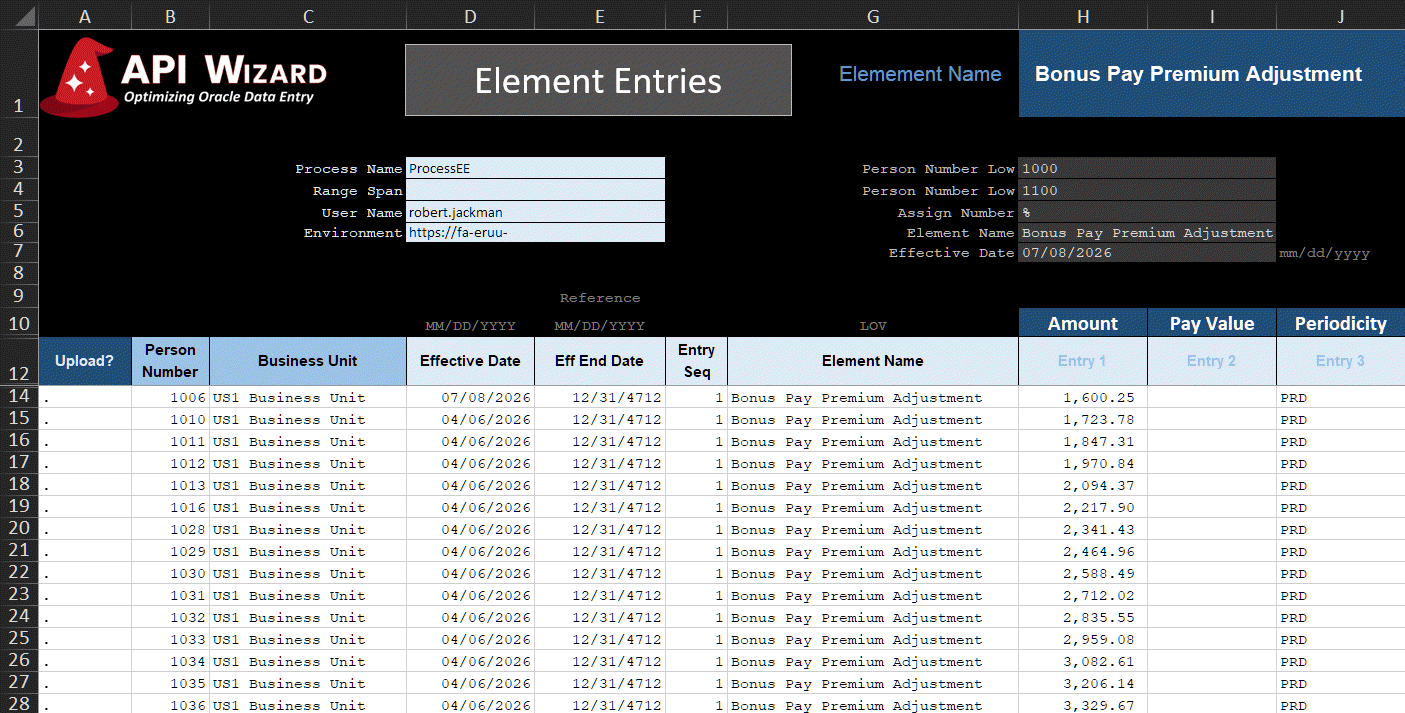
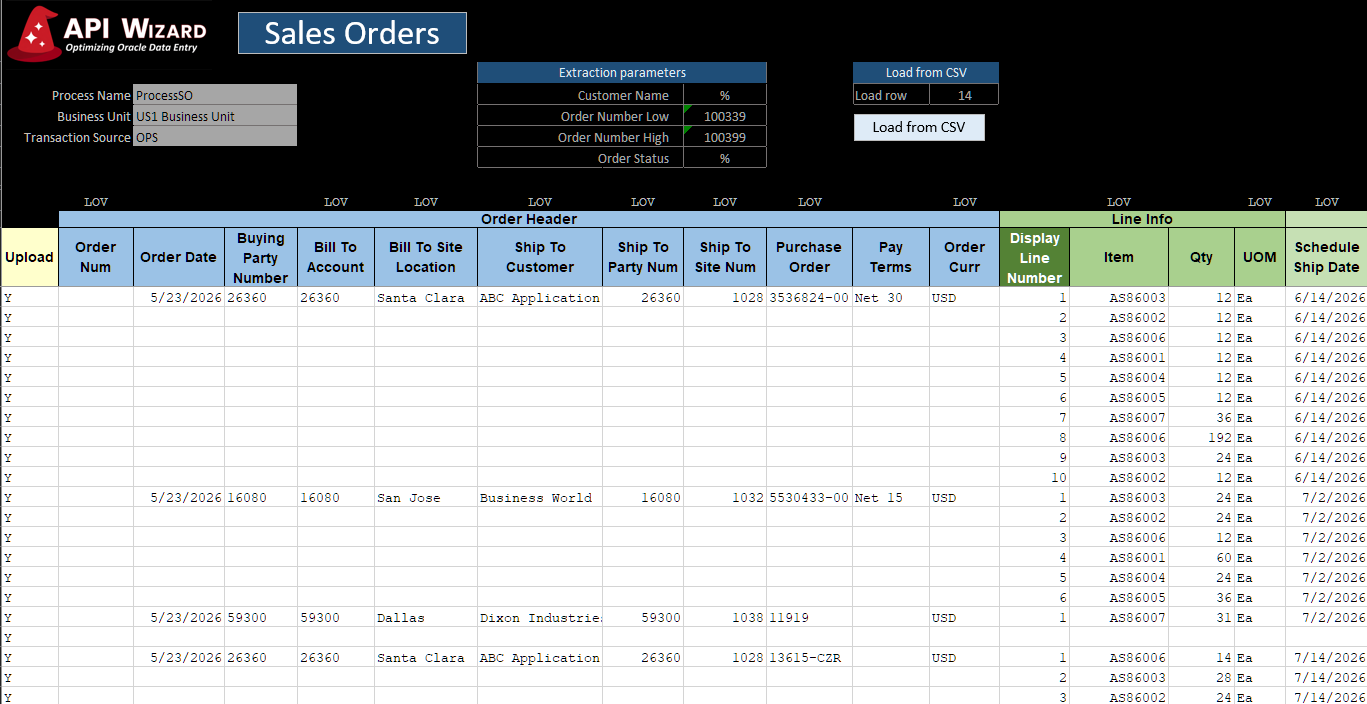
This is what a Loader looks like
Your team stays in Excel while the structure, lists of values and validation all come from your own Oracle instance.
Why Oracle teams switch to API Wizard
01
One set of spreadsheets for EBS and Fusion Cloud
The same Excel sheets work on both Oracle platforms, so nothing is relearned when you move. Loaders are easy to configure to your requirements — you do not need a different sheet for every scenario.
02
Secure and audit-ready
Enforces your existing Oracle roles and privileges, with a complete audit trail, attachments and approvals.
03
Hours back, every week
Customers report up to a 95% reduction in data entry time. Manual re-keying and spreadsheet clean-up disappear.
04
Live in weeks, not months
Start from a pre-configured template against your sandbox and teams are running real loads within weeks. No custom development, no configuration phase to budget for, no consultant on retainer.
05
Automation that removes the repeat work
Schedule recurring loads and chain steps across modules, so routine month-end work runs itself instead of occupying someone for a day.
06
Support from the people who build it
Questions go to the team that writes the product, not to a ticket queue — and product gaps get fixed rather than logged.
Where it delivers the most value
Daily Oracle data maintenance
Manage items, load invoices, update suppliers, and much more.
Master data governance
Enforce standards and approvals while still moving quickly.
Large data updates
Price changes, BOM updates and mass attribute changes at volume.
Implementations and migrations
Accelerate cutover and project data loads.
Data cleanup projects
Find and correct bad data at scale.
See why Oracle teams choose API Wizard
15-minute demo. Your data, your modules, your questions.